
If you have been told you have a bulging disc, there is a good chance you have also been told a bunch of different things about what that means.
Some people make it sound terrifying. Some people brush it off like it is nothing. And somewhere in the middle is the truth.
A bulging disc is not always an emergency. It does not automatically mean you need surgery. And no, it does not mean your spine is “destroyed.” But it can absolutely cause real pain, stiffness, nerve irritation, sciatica, numbness, weakness, and that frustrating feeling where your back just does not trust you anymore.
So the real question becomes this:
Can spinal decompression help a bulging disc?
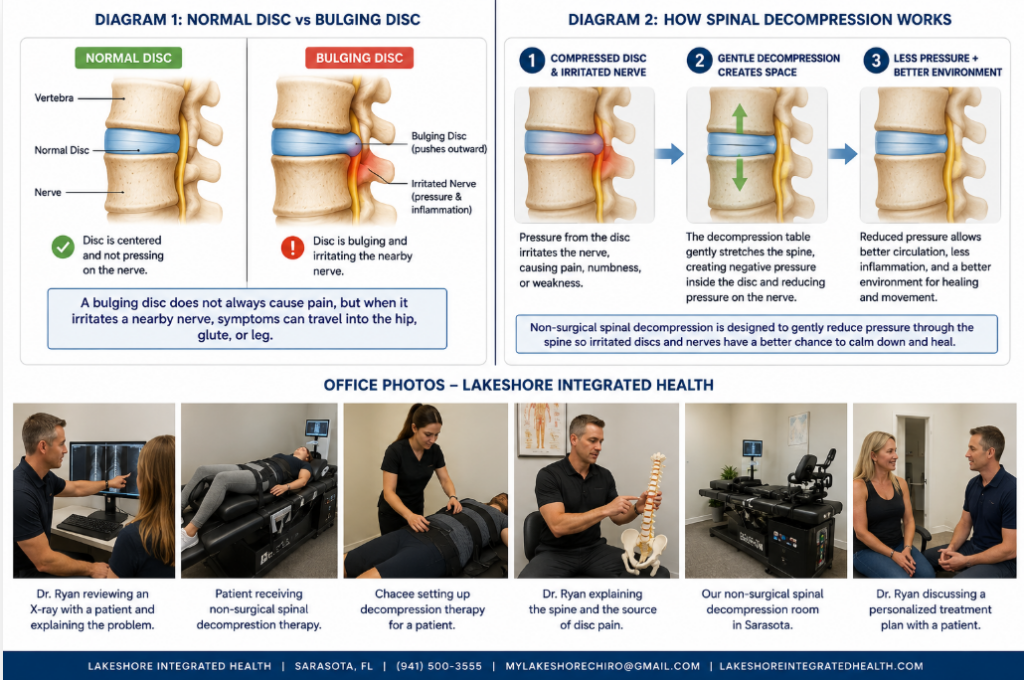
The answer is: in many cases, yes — especially when the problem is related to pressure, irritation, and poor movement around the disc. Non-surgical spinal decompression is designed to gently reduce pressure through the spine and give irritated discs and nerves a better environment to calm down. Cleveland Clinic describes spinal decompression as treatment that may help relieve back pain by taking pressure off the spine’s neural structures.
At our office in Sarasota, this is one of the main reasons we use non-surgical spinal decompression for patients dealing with disc issues, bulging discs, herniated discs, low back pain, and sciatica. But here is the part I want to be very clear about:
Spinal decompression is not magic. It is a tool. A very useful tool when it is used correctly, for the right patient, with the right plan.
And that last part matters.
What Is a Bulging Disc?
Your spinal discs sit between the bones of your spine. I usually explain them like shock absorbers. They help your spine move, bend, absorb pressure, and handle load.
A bulging disc happens when the disc starts to push outward beyond where it normally should be. Think of it like stepping on one side of a jelly donut. The outside wall starts to bow out. Sometimes that bulge is mild and causes no symptoms. Other times, it can irritate nearby nerves and create pain that travels into the hips, glutes, legs, or even down into the foot.
That is why one person can have a bulging disc on an MRI and feel totally fine, while another person has the same-looking report and can barely get out of bed.
The MRI matters. But your symptoms, exam findings, strength, mobility, nerve function, posture, and daily habits matter too.
That is where a good evaluation comes in.
What Does Spinal Decompression Actually Do?
Non-surgical spinal decompression is a therapy that gently stretches the spine in a controlled way. The goal is to reduce pressure on the discs and nerves, especially in areas where the spine may be compressed, irritated, or not moving well.
This is different from someone just “pulling on your back.” A proper spinal decompression table is designed to create a specific, controlled pull through the spine. For disc problems, that matters because we are not just chasing pain — we are trying to change the pressure environment around the irritated area.
When someone has a bulging disc, the disc may be under too much pressure. The joints around it may be stiff. The muscles may be guarding. The nerve may be irritated. The body may start moving differently just to avoid pain.
Spinal decompression is meant to help create space, calm irritation, and reduce mechanical stress on the area.
That is why we often use decompression as part of a bigger plan for:
- Bulging discs
- Herniated discs
- Sciatica
- Disc-related low back pain
- Nerve irritation into the leg
- Degenerative disc issues
Mayo Clinic notes that conservative care is often the first line of treatment for herniated disc symptoms and that many people improve without surgery.
That does not mean everyone gets better with decompression. But it does mean that non-surgical care should be taken seriously before jumping straight to invasive options, unless there are serious red flags.
Can Spinal Decompression Pull a Disc Back In?
This is where I want to be honest.
You may see some offices online make it sound like decompression “sucks the disc back in” like a vacuum cleaner.
I do not love that explanation.
The body is more complicated than that.
A better way to think about it is this: spinal decompression may help reduce pressure around the disc and nerve so the body has a better chance to calm inflammation, improve movement, and reduce symptoms. Some research has looked at traction and decompression-style therapies for lumbar disc herniation and found improvements in pain and function in certain patient groups, but this is not a guaranteed “disc repair button.”
The truth is, your body heals better when it is not constantly being irritated.
That is the goal.
Not hype.
Not magic.
Just better mechanics, less pressure, better movement, and a smarter plan.
How Do I Know If My Bulging Disc Is Causing My Pain?
This is a huge point.
Just because an MRI says “bulging disc” does not automatically mean that bulge is the reason you hurt.
A lot of people have disc bulges and do not even know it. Mayo Clinic notes that some people can have a herniated disc without symptoms, and it may only show up on imaging.
That is why we do not treat MRI reports. We treat people.
When I am looking at a possible disc case, I want to know:
Does the pain travel down the leg? Is there numbness or tingling? Is there weakness? Does coughing, sneezing, sitting, bending, or driving make it worse? Does the patient lean to one side? Are reflexes normal? Can they tolerate extension? Flexion? Compression? Does decompression testing relieve pressure or make it worse?
That is how you start to figure out if the disc is actually part of the pain picture.
Because sometimes the disc is the main problem. Sometimes it is part of the problem. And sometimes it is just an innocent bystander that got blamed because it showed up on the MRI.
Why Chiropractic Alone May Not Be Enough for a Bulging Disc
I am a chiropractor, so let me say this clearly:
Chiropractic adjustments can be very helpful, but chiropractic alone is not always enough for disc cases.
That is not a knock on chiropractic. That is just reality.
If someone has a true disc issue with nerve irritation, muscle guarding, weakness, poor core stability, pelvic instability, or years of compensation, one adjustment is not going to magically rebuild the whole system.
An adjustment can help restore motion. It can help reduce joint restriction. It can help the nervous system calm down. But if the disc is compressed, the muscles are weak, and the body keeps moving the same broken way every day, you need more than a quick pop and a prayer.
That is why our office is set up differently.
At Lakeshore Integrated Health, we still do chiropractic care, but we also have non-surgical spinal decompression, corrective exercises, soft tissue support, advanced therapies, and muscle strengthening options to help support the spine from multiple angles.
Because when someone has a bulging disc, the goal should not just be, “Can we get your pain down for a few days?”
The better question is:
Can we help your spine become stronger, more stable, and less likely to keep falling into the same pattern?
That is the difference.
What a Good Bulging Disc Treatment Plan Should Include
A good plan for a bulging disc should not be random.
It should be based on the patient’s exam, symptoms, imaging when needed, strength, movement, and goals.
For many disc patients, the plan may include non-surgical spinal decompression to help reduce pressure, chiropractic adjustments to improve joint motion, corrective exercises to retrain movement, and eventually strengthening work to help the spine tolerate life again.
That last part is big.
Pain relief is only step one.
If your pain goes away but your spine is still weak, unstable, and scared to move, you are not done. You are just in the quiet part of the problem.
This is where strengthening becomes important. Once symptoms calm down and the patient can move better, we may start building strength through corrective exercises and, in some cases, technologies like Emsculpt Neo to help activate and strengthen the core and spinal support muscles.
Not because Emsculpt Neo “fixes” a disc.
It does not.
But because a stronger core and better muscle support can help reduce stress on the spine over time. And for a lot of chronic back pain patients, weakness and poor muscle control are part of the reason the problem keeps coming back.
Is Spinal Decompression Better Than Surgery?
Not always.
And anyone who tells you decompression is “better than surgery” for every case is overselling.
Surgery has a place. If someone has progressive weakness, severe nerve compression, loss of bowel or bladder control, or symptoms that are not improving despite appropriate care, they need the right medical referral. Mayo Clinic lists surgery as a consideration when conservative treatment fails after several weeks or when nerve weakness causes trouble standing or walking.
But many people with disc-related pain do not start there.
Many people are better served by trying a conservative, non-surgical plan first — especially if there are no major neurological red flags.
That is where spinal decompression may fit beautifully.
It gives patients another option between “just live with it” and “go talk to a surgeon.”
And honestly, that is where a lot of people are stuck.
They have already tried medication. They have already tried random stretches from YouTube. They may have tried basic chiropractic or physical therapy. They are not ready for surgery. But they are also tired of being told, “Just give it time.”
That middle ground is exactly why our office is built the way it is.
How Many Spinal Decompression Sessions Does a Bulging Disc Need?
This depends on the person.
Some patients feel a difference quickly. Others need more time because the disc, nerve, inflammation, and muscle guarding have been there for months or years.
In general, disc cases are not usually a “one and done” situation. If a disc has been irritated long enough to create sciatica, weakness, numbness, or chronic low back pain, we have to respect that.
A typical plan may involve a series of decompression sessions over several weeks, combined with the right supportive care. The exact number depends on severity, symptoms, imaging, exam findings, and how the patient responds early in care.
The goal is not to keep someone in treatment forever.
The goal is to get the pressure down, improve movement, build stability, and help the patient understand what their back actually needs.
Because once you understand the problem, you are not just guessing anymore.
And that is powerful.
When Should You Not Ignore a Bulging Disc?
Most disc cases are not emergencies, but some symptoms need to be taken seriously.
If you have significant leg weakness, worsening numbness, trouble walking, loss of bowel or bladder control, numbness in the groin/saddle area, fever, unexplained weight loss, history of cancer, or severe pain after trauma, you should seek medical care right away.
Those are not “wait and see” symptoms.
That is not the time to tough it out.
But if you have low back pain, sciatica, stiffness, disc pressure, or pain that has not improved with basic care, then getting evaluated for non-surgical spinal decompression may be a smart next step.
Frequently Asked Questions About Spinal Decompression and Bulging Discs
Can spinal decompression help sciatica from a bulging disc?
Yes, it may help in some cases. If the sciatic nerve is being irritated by pressure or inflammation near a disc, decompression may help reduce stress in that area. Sciatica can come from multiple causes though, so the exam matters.
Is spinal decompression painful?
It should not feel painful. Most patients describe it as a gentle pulling or stretching feeling. Some patients actually find it relaxing. If decompression increases symptoms, the plan may need to be adjusted.
Is a bulging disc the same as a herniated disc?
Not exactly. A bulging disc usually means the disc is pushing outward more broadly. A herniated disc usually means the inner material of the disc has pushed farther through the outer layer. Both can irritate nerves, and both can be treated conservatively in many cases.
Do I need an MRI before spinal decompression?
Not always, but sometimes yes. If symptoms are severe, worsening, or involve neurological signs like weakness or numbness, imaging may be needed. At our office, we look at the full picture: history, exam, X-rays when clinically necessary, MRI findings when available, and how your body is actually functioning.
Can chiropractic adjustments help a bulging disc?
They can help, but they are not always enough by themselves. In disc cases, we often need to combine adjustments with non-surgical spinal decompression, corrective exercises, and strengthening so we are not just chasing pain.
The Bottom Line: Can Spinal Decompression Help a Bulging Disc?
Yes, spinal decompression may help many people with bulging discs, especially when the pain is related to disc pressure, nerve irritation, sciatica, or spinal compression.
But the best results usually do not come from decompression alone.
They come from a plan.
A real plan.
One that looks at the disc, the joints, the nerves, the muscles, the core, the pelvis, and the way the person moves every single day.
At Lakeshore Integrated Health in Sarasota, that is exactly how we approach disc cases. We are still a chiropractic office at heart, but we are built to handle more complicated back pain cases with more than one tool.
Because if your bulging disc has been making you feel stuck, limited, or afraid to move, the answer is not always surgery.
Sometimes the answer is creating space, calming the nerve, restoring motion, and rebuilding support around your spine.
That is what non-surgical spinal decompression is designed to help with.
And that is where we can help.
At Lakeshore Integrated Health, we help people in Sarasota and the surrounding areas find real answers for back pain, disc issues, sciatica, core weakness, pelvic floor dysfunction, and more.
📍 Sarasota, FL 📞 Call or text: 941-500-3555 📧 Email: Mylakeshorechiro@gmail.com 🌐 Visit: lakeshoreintegratedhealth.com
If you’re tired of guessing, let’s take a real look at what’s going on.