
One of the most common questions I get from patients at Lakeshore Integrated Health in Sarasota, FL is simple:
“How long does spinal decompression take to work?”
And honestly, it is a fair question.
When your back hurts, your leg is tingling, your disc is irritated, or you feel like every movement is a gamble, you do not want vague answers. You want to know when you might start feeling better, how many visits it may take, and whether non-surgical spinal decompression is actually worth your time.
So here is the real answer.
Some patients feel relief within the first few visits. Some need a few weeks before they notice a major change. And patients with more serious disc issues, chronic sciatica, herniated discs, bulging discs, spinal stenosis, or long-term low back pain may need a more structured plan over several weeks.
The key thing to understand is this:
Spinal decompression is not usually a one-visit miracle. It is a process designed to reduce pressure, calm irritated nerves, improve movement, and give the spine a better environment to heal.
At Lakeshore Integrated Health, formerly known as Lakeshore Chiropractic, we use spinal decompression as part of a bigger plan for patients in Sarasota, Bradenton, Lakewood Ranch, Palmer Ranch, Siesta Key, Venice, and the surrounding areas who are dealing with disc-related back pain and sciatica.
What Is Spinal Decompression Supposed to Do?
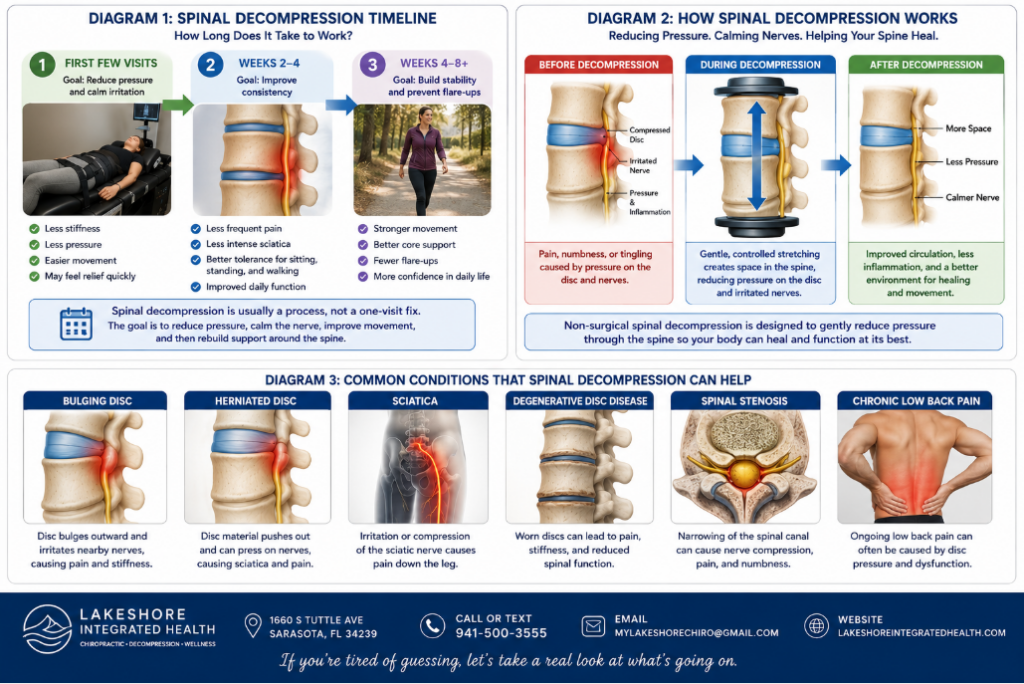
Non-surgical spinal decompression is a treatment designed to gently stretch the spine and reduce pressure around irritated discs, joints, and nerves.
That is the clean medical explanation.
Here is how I explain it to patients.
If a disc is irritated, compressed, or pushing near a nerve, your body may react with pain, inflammation, muscle guarding, stiffness, numbness, tingling, or weakness. Spinal decompression is designed to gently create space and reduce stress in that area.
It does not “force” healing.
It creates a better environment for healing.
That difference matters.
Because if your disc and nerve are getting irritated every single day, your body has a harder time calming down. Decompression helps take some of that pressure off so the spine can start moving in the right direction.
So, How Long Does Spinal Decompression Take to Work?
Most patients want a number, so I’ll give you a realistic framework.
Some people notice improvement after 1 to 3 sessions. That may feel like less pressure, easier movement, less leg pain, or less stiffness getting up from a chair.
A lot of patients start noticing more consistent changes around 2 to 4 weeks, especially when decompression is being done regularly and paired with the right exercises, movement changes, and chiropractic care.
More involved disc cases may take 6 to 12 weeks or longer, depending on the severity of the problem.
That does not mean every patient needs 12 weeks.
It means disc and nerve problems need to be respected.
If your back pain started last week, your timeline may be different than someone who has had sciatica for 8 months, weakness in the leg, poor core stability, and an MRI showing a herniated disc.
That is why we do not treat every decompression patient the same way.
Why Some People Feel Better Fast
Some patients feel better quickly because their pain is mainly coming from pressure, muscle guarding, inflammation, or joint compression that responds well to decompression.
These patients may say things like:
“I feel lighter.” “I can stand up straighter.” “My leg pain is not as sharp.” “I slept better after treatment.” “I still feel it, but it is not screaming at me anymore.”
That is a good sign.
But early relief does not mean the problem is fully fixed.
This is where people mess up.
They feel 40% better, go do yard work, lift something dumb, sit in a car for 5 hours, or stop care too early — and then the pain comes roaring back.
Pain relief is step one.
Stability is step two.
Strength is step three.
That is why at Lakeshore Integrated Health in Sarasota, we care about more than just “does it hurt today?” We want to know if your spine is actually becoming more stable and more reliable.
Why Some People Take Longer
Some spinal decompression patients need more time because the problem has been there longer or involves more than just one irritated disc.
If someone has a bulging disc, herniated disc, degenerative disc disease, spinal stenosis, chronic sciatica, or weakness into the leg, we have to be more patient and more strategic.
A disc problem is not like a light switch.
It is more like turning down the heat on a fire.
You reduce pressure. You calm irritation. You improve movement. You retrain the muscles. You build support. Then the body starts trusting movement again.
That takes time.
And the longer your body has been guarding, compensating, and moving poorly, the longer it may take to unwind that pattern.
How Many Spinal Decompression Sessions Do You Need?
There is no perfect number that applies to every patient.
Some mild cases may respond in a shorter window. More serious disc cases often need a structured plan over several weeks. For many patients, decompression works best when it is done consistently enough to create a real change, not randomly whenever the pain gets bad.
That is why I do not love the idea of doing decompression once, waiting three weeks, doing it again, and then wondering why nothing changed.
That is like going to the gym once, eating one salad, and asking where your six-pack is.
The body needs repetition.
With disc issues, the goal is to repeatedly reduce pressure and calm irritation long enough for the spine to settle down. Then we can start layering in better movement and strengthening.
At Lakeshore Chiropractic / Lakeshore Integrated Health, we often combine decompression with chiropractic adjustments, corrective exercises, soft tissue work, and later strengthening options when appropriate.
Because decompression helps reduce pressure.
But strength helps keep you from living in the same cycle forever.
What Should You Feel During Spinal Decompression?
Most patients describe spinal decompression as a gentle pulling or stretching sensation. It should not feel aggressive, scary, or painful.
Some patients feel relief while they are on the table. Others feel more relaxed afterward. Some feel a little sore at first because the body is not used to that type of stretch and pressure change.
That mild soreness can happen.
But sharp pain, worsening leg symptoms, or increasing numbness is not something to ignore. That is why the treatment has to be monitored and adjusted based on the patient.
At our office in Sarasota, FL, we are not just putting people on a table and hoping for the best. We are watching how your body responds and adjusting the plan as needed.
That is the difference between using equipment and actually practicing healthcare.
Is Spinal Decompression Enough by Itself?
Sometimes decompression is the biggest missing piece.
But most of the time, it should not be the only piece.
This is where I want to be very direct.
If someone has a disc problem, weak core, poor posture, stiff hips, pelvic instability, bad lifting habits, and zero strength around the spine, decompression alone may help them feel better — but it may not be enough to keep them better.
That is why our office is built differently.
At Lakeshore Integrated Health in Sarasota, we are still a chiropractic office at heart. But we also use non-surgical spinal decompression, corrective exercises, advanced muscle strengthening, Emsculpt Neo when appropriate, Emsella for pelvic floor support when relevant, and other therapies to help patients get more complete care.
Because if your spine keeps breaking down under the same pressure, we have to ask a better question:
Why does your back keep losing the fight?
Sometimes the answer is the disc.
Sometimes it is weakness.
Sometimes it is poor movement.
Sometimes it is your core and pelvic floor not doing their job.
And many times, it is a combination.
When Should You Expect Real Improvement?
A good sign is when symptoms become less intense, less frequent, or less widespread.
For example, if your pain used to travel all the way down your leg but now it mostly stays in the low back, that can be progress. If sitting used to trigger pain in 5 minutes and now you can sit for 25 minutes, that is progress. If you are sleeping better, walking better, standing taller, or taking fewer “careful” steps, that matters.
Healing is not always a straight line.
Disc cases can be weird.
You may have a great day, then a sore day. You may feel less leg pain but more centralized back stiffness. You may feel better after decompression but still need time to build strength and confidence.
That does not mean it is not working.
It means we need to track the right things.
Pain level matters, but function matters more.
Can you walk farther? Can you sit longer? Can you get out of bed easier? Can you work without flaring up? Can you play with your kids without feeling like your back is made of glass?
That is the stuff I care about.
How Do I Know If Spinal Decompression Is Right for Me?
Spinal decompression may be a good fit if you have low back pain, disc pressure, bulging disc, herniated disc, sciatica, pain with sitting, pain into the hip or leg, or symptoms that feel worse with compression.
But it is not for everyone.
That is why the evaluation matters.
At Lakeshore Integrated Health, Dr. Ryan Vanlandschoot looks at your history, symptoms, exam findings, movement, posture, strength, X-rays when clinically necessary, and MRI findings if you already have them.
We are trying to answer the real question:
Is your pain coming from a problem decompression can actually help?
Because if the answer is yes, great. We build a plan.
If the answer is no, we need to be honest about that too.
Good care starts with not guessing.
Frequently Asked Questions About Spinal Decompression
How long does it take spinal decompression to work?
Some patients feel improvement after the first few sessions, while many notice more consistent changes after 2 to 4 weeks. More serious disc or sciatica cases may take 6 to 12 weeks or longer depending on severity, nerve involvement, and how long the problem has been there.
How many spinal decompression treatments do I need?
It depends on your condition. Mild back pain may need fewer visits, while bulging discs, herniated discs, chronic sciatica, or degenerative disc problems often require a more structured plan. The goal is not just temporary relief. The goal is pressure reduction, better movement, and long-term support.
Can spinal decompression help sciatica?
Yes, spinal decompression may help sciatica when the sciatic nerve is being irritated by disc pressure or spinal compression. But sciatica can have multiple causes, so a proper exam is important.
Is spinal decompression better than chiropractic adjustments?
They do different things. Chiropractic adjustments help restore joint motion and improve spinal function. Spinal decompression is more focused on reducing pressure around discs and nerves. For disc cases, combining both can often make more sense than relying on one tool alone.
Can spinal decompression help a herniated disc?
It may help certain herniated disc cases by reducing pressure and calming nerve irritation. Many herniated disc symptoms improve with conservative care, although serious or worsening nerve symptoms may need medical referral.
When should I worry about back pain or sciatica?
If you have worsening leg weakness, trouble walking, loss of bowel or bladder control, numbness in the groin or saddle area, fever, unexplained weight loss, or severe pain after trauma, get medical care right away. Those are not symptoms to ignore.
The Bottom Line: How Long Does Spinal Decompression Take to Work?
Spinal decompression can start helping some patients within the first few visits, but most disc and sciatica cases need consistent care over several weeks to see meaningful change.
The real goal is not just quick pain relief.
The goal is to reduce pressure, calm nerve irritation, improve spinal movement, rebuild support, and help your back become more reliable.
At Lakeshore Integrated Health, Dr. Ryan Vanlandschoot and our team help patients in Sarasota, FL, Bradenton, Lakewood Ranch, Palmer Ranch, Siesta Key, Venice, and surrounding areas with non-surgical spinal decompression, chiropractic care, corrective exercises, and advanced therapies designed to support the spine from multiple angles.
If you have a bulging disc, herniated disc, sciatica, or low back pain that keeps coming back, decompression may be one of the tools your spine needs.
Not magic.
Not hype.
Just a smarter way to reduce pressure and help the body move in the right direction.
Lakeshore Integrated Health
At Lakeshore Integrated Health, Dr. Ryan Vanlandschoot and our team help patients in Sarasota, FL and surrounding areas get real answers for back pain, disc issues, sciatica, core weakness, pelvic floor dysfunction, and whole-body performance.
📍 Lakeshore Integrated Health 3425 University parkway unit 101 Sarasota, FL 34243
📞 Call or Text: 941-500-3555
📧 Email: Mylakeshorechiro@gmail.com
🌐 Website: lakeshoreintegratedhealth.com
If you’re tired of guessing, let’s take a real look at what’s going on.