
Most people who walk into a healthcare provider’s office with back pain leave with one of a handful of standard responses: a prescription for anti-inflammatories, a referral to physical therapy, a recommendation to rest and follow up in two weeks, or in more serious cases, a conversation about injections or surgery. These are not bad options in isolation. But they share a common limitation. They are designed to manage what the patient is feeling, not necessarily to understand and address why they are feeling it.
That gap between symptom management and root-cause resolution is exactly what integrated care is meant to close. At Lakeshore Integrated Health, that is not a marketing phrase. It is a structural commitment to building every patient’s treatment plan around their specific diagnosis, their specific body, and their specific goals.
The Problem With Treating the Symptom
Pain is a signal, not a diagnosis. It tells you that something in the body needs attention, but it does not tell you what that something is, where it originates, or what combination of factors is driving it. When treatment targets the signal without identifying the source, one of two things typically happens. Either the pain returns because nothing underlying has changed, or it shifts, showing up somewhere else as the body continues to compensate around an unresolved problem.
This is the experience that brings many patients to Lakeshore after years of cycling through treatments that provided temporary relief without lasting resolution. A cortisone injection may reduce inflammation around a compressed nerve, but if the disc that is compressing that nerve remains herniated and the core muscles that should be stabilizing the spine remain weak, the inflammation will return. The signal comes back because the source was never addressed.
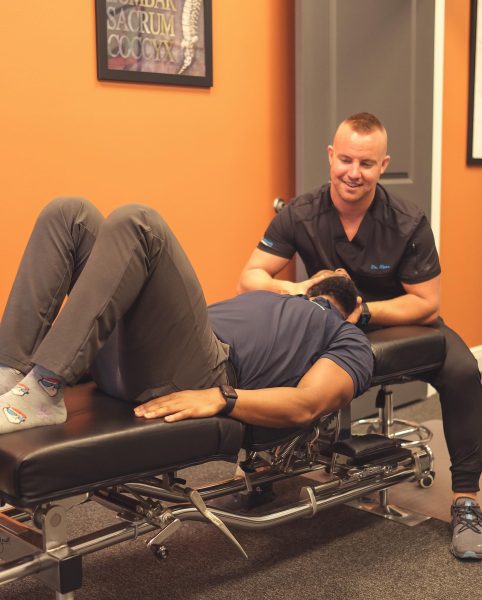
What Root-Cause Analysis Actually Looks Like
Identifying the root cause of a spinal or musculoskeletal problem requires looking at the full picture: structural alignment, disc integrity, nerve function, muscle strength and activation patterns, and the relationship between all of those elements. At Lakeshore Integrated Health, that process begins before any treatment is recommended.
A patient presenting with lower back pain and sciatica, for example, may be experiencing symptoms that have three or four contributing factors. There may be a herniated disc creating direct nerve compression. There may be spinal misalignment increasing the pressure on that disc. There may be deep stabilizing muscles that have become inhibited due to chronic pain, leaving the spine unsupported during movement. And there may be postural habits or movement patterns reinforcing the problem every day. Treating the sciatica with a single modality addresses one thread of a much more complex picture.
Understanding the full picture is what makes it possible to build a plan that actually resolves the problem rather than quieting it temporarily.
How Personalized Plans Are Built
No two patients at Lakeshore Integrated Health receive the same protocol, because no two patients present with the same combination of structural, muscular, and neurological factors. A plan is built based on what the evaluation reveals, not based on a standard template for a given diagnosis.
For one patient, the primary driver may be disc compression that is best addressed through a structured course of spinal decompression therapy, which creates negative pressure within the affected disc and encourages retraction of herniated material while restoring hydration and disc height. Chiropractic adjustments may be incorporated to correct the alignment issues that contributed to the disc problem in the first place. BTL therapy may then be added to rebuild the deep core and spinal stabilizer muscles that will hold the corrected structure in place once decompression and adjustments have done their work.
For another patient, the structural component may be less significant than the neuromuscular one. Years of compensating around pain may have left the stabilizing muscles of the spine chronically underactive and the larger, less precise muscles chronically overloaded. In that case, the primary focus may shift toward BTL HIFEM therapy to directly stimulate and rebuild those deep muscles through electromagnetic activation, combined with chiropractic care to address the alignment consequences of those compensation patterns.
The combination, the sequencing, and the pacing of treatment all depend on what the individual patient needs. That is what personalized means in practice, as opposed to in a brochure.
What Patients Can Realistically Expect
Integrated care is not a faster version of conventional treatment, and it is not a guarantee of a specific outcome. It is a more thorough and more logical approach to a problem that conventional treatment has often left partially unsolved. That distinction matters when setting expectations.
Patients who come to Lakeshore with chronic conditions that have been building for years should understand that resolving those conditions takes time. Structural changes to the spine, neuromuscular retraining, and disc rehydration are biological processes that happen on the body’s timeline, not on an arbitrary schedule. What integrated care offers is not a shortcut. It is a path that actually leads somewhere, rather than cycling through the same temporary fixes indefinitely.
Most patients begin to notice meaningful change within the first few weeks of a structured plan. The quality of that change tends to differ from what they experienced with symptom-focused treatment. Rather than feeling better and then returning to baseline, they find that the improvement accumulates and holds. Adjustments last longer. Movement feels more natural. Activities that previously triggered pain become more manageable. That trajectory is what distinguishes treatment that is working at the source from treatment that is working at the surface.
Why This Approach Requires More From Everyone
Integrated care asks more of the provider and the patient alike. It requires a thorough initial evaluation rather than a quick intake. It requires honest communication about what each modality is expected to accomplish and why. It requires patients who are willing to commit to a plan rather than expecting a single visit to resolve a problem that developed over years.
At Lakeshore Integrated Health, that level of engagement is something we consider part of the care itself. Understanding what is driving your pain, what the plan is designed to address, and what your role is in the process makes you an active participant in your own recovery rather than a passive recipient of treatment.
If you are in the Bradenton or Sarasota area and you have been managing pain without making progress toward resolving it, a consultation at Lakeshore is a conversation worth having. We will take the time to understand your history and your goals, and we will be straightforward with you about what we think will help and why. Contact us today to get started.